.svg)
.svg)
.svg)
.svg)




Hybrid work: our guide to a smooth transition for your company

Today, there are almost as many work models as there are companies. The days when every employee had fixed office hours and worked only at the company’s premises are gone. The evolution of technology and society has led to new ways of working, with greater flexibility. Among these new approaches, accelerated by the Covid pandemic, is hybrid work. But what exactly does it mean? What are its benefits? How can you overcome its challenges? This guide answers all these questions.
What is hybrid work?
Hybrid work combines on-site work and remote work. Let’s start with these two concepts:
- On-site work, or office work, is the traditional model where employees carry out their activities within the company’s premises.
- Remote work, or teleworking, means doing your job outside the office, at home, in a coworking space, in a café, or even on a train.
In a hybrid model, employees divide their time between the office and another workplace. The balance depends on the company. It might be two days in the office and three days working remotely, or mornings in the office and afternoons from home.
Some organisations set a strict framework with mandatory office days, while others allow employees more freedom. Even within the same company, teams may operate differently. For instance, web developers often expect full remote work, and it is hard to hire them otherwise. Cross-team collaboration naturally becomes hybrid.
Hybrid work also often brings more flexible schedules. The focus shifts from the number of hours worked to the outcomes and completed tasks.
What are the advantages of hybrid work?
Splitting time between the office and home, or another location, offers major advantages, both for individuals and for organisations as a whole.
More freedom and flexibility
While salary and job content are key for job seekers, flexibility also plays an important role. Hybrid work makes this possible. On remote days, employees can choose where they work and sometimes when they work.
This flexibility removes daily constraints like early wake-ups, long commutes, or fixed lunch breaks. It is a strong advantage for HR teams looking to attract talent, as flexibility has become a key decision factor for many candidates.
At the same time, working part of the week in the office helps maintain a good rhythm and connection to the company.
A better work-life balance
Medical appointments, school runs, or an evening workout can be hard to manage with a 100% office schedule. Hybrid work makes this easier. Employees can adapt their timetable more freely on remote days.
It also avoids the need to take a full day off when public transport is disrupted or a child is ill. Paid leave can then be used for holidays or personal projects instead.
Working from home also saves commute time, which can be used for rest or personal activities.
In the end, hybrid workers enjoy a healthier balance between personal and professional life. This improves satisfaction, well-being, and productivity. Happier employees perform better.
Increased productivity
Productivity is often at the heart of discussions about hybrid work. Some employers worry that people will work less effectively at home. Yet studies show the opposite: productivity can actually increase.
Why?
Several reasons explain this:
- Less fatigue thanks to reduced commuting.
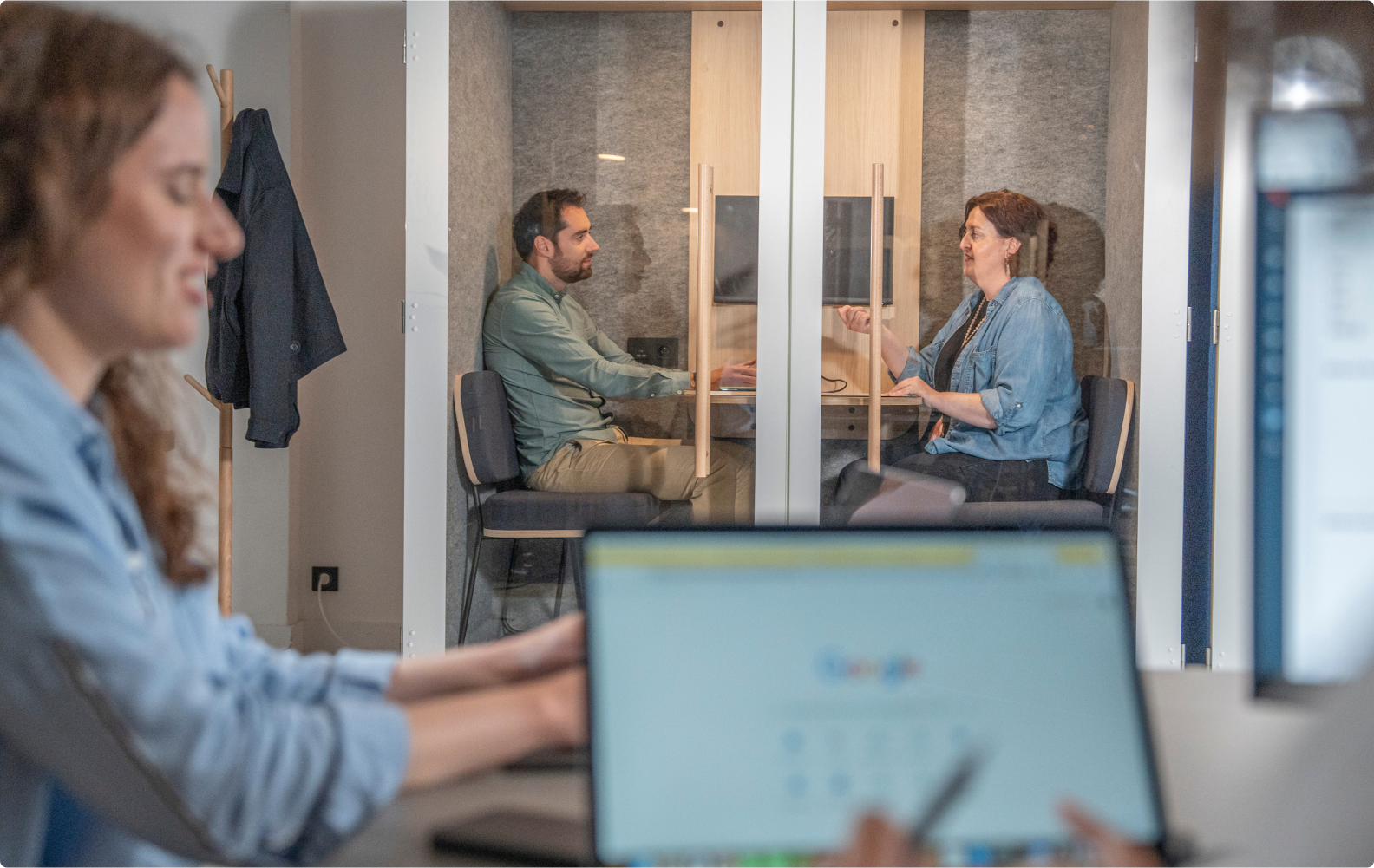
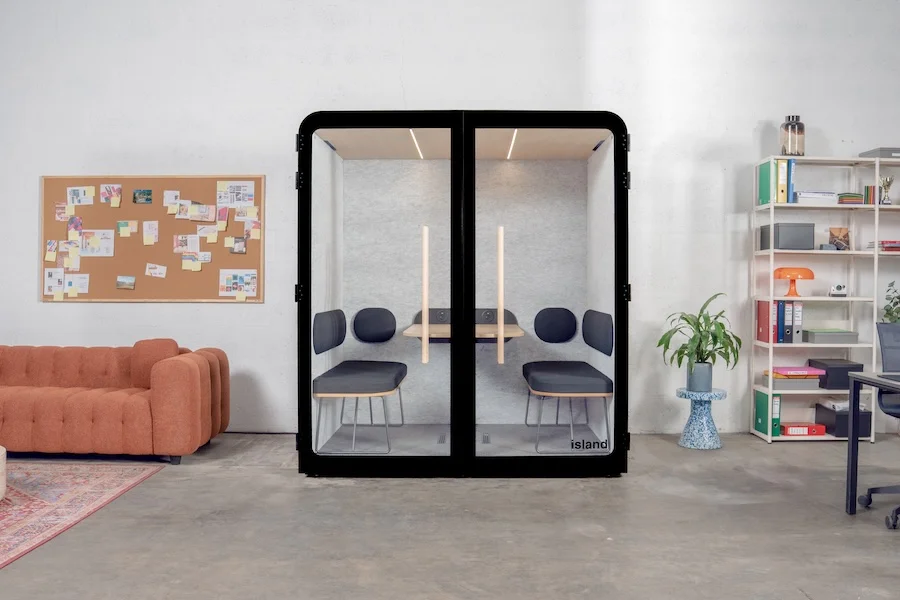
- Fewer distractions and interruptions from colleagues, which can also be addressed in offices with acoustic pods.
- Lower stress, with the freedom to take breaks when needed, without fear of judgment.
However, full remote work can have drawbacks such as poor communication or unhealthy work habits.
To make hybrid work successful, workplaces must be adapted for collaboration. Meetings, for example, are difficult when only part of the team is present. Connected meeting rooms are essential, and acoustic booths are a smart way to add soundproof spaces with minimal use of floor space.
Under the right conditions, the hybrid model can truly enhance productivity.
Lower costs for both employees and employers
The financial aspect also matters. Working remotely a few days a week means fewer commuting expenses, especially for employees who live far from the office.
It also reduces small daily costs: less money spent on transport, coffee breaks, or eating out, and more chances to cook at home.
That said, remote work can increase some expenses, such as electricity. Companies can help by offering allowances or support for home office costs.
For employers, savings can also be significant. Fewer people on site at the same time means smaller office spaces, less rent, lower heating and cleaning costs, and fewer desks and furniture needs.
What are the risks and challenges of hybrid work?
Despite its clear advantages, hybrid work is not perfect. It comes with challenges that companies must address carefully.
Unequal working conditions
When everyone works in the same office, all employees share the same facilities, canteen, and equipment. With home office days, the situation varies greatly. Some people have a quiet, well-equipped workspace, while others face noise, limited space, or distractions.
Limited access to tools and data
For security reasons, some companies restrict access to sensitive data or systems, allowing them only on site. This can make it difficult to complete tasks remotely. Implementing secure remote access solutions is essential to avoid this issue.
Weakened company culture and team cohesion
Building a strong company culture is one of the biggest challenges in hybrid work. When employees work on different schedules and do not see each other regularly, it is harder to build relationships and a sense of belonging.
Team-building events, off-sites, or company gatherings are key to maintaining cohesion and helping new hires integrate well.
Overconnection and overwork
Another major risk of hybrid work is overworking. In an office, working hours are naturally limited by opening times. At home, boundaries blur. With laptops and phones always nearby, some employees find it hard to disconnect.
Occasional extra hours are fine, but constant overwork can harm mental health. Clear boundaries and a right-to-disconnect policy are crucial.
How to make hybrid work successful
To overcome these challenges, companies can take several practical steps to make hybrid work effective for everyone.
Provide the right tools
This includes both equipment such as laptops, phones, or tablets, and digital tools. Employees need everything required to work efficiently from anywhere: shared calendars, video-conferencing platforms, internal social networks, and project management tools, while keeping data secure.
Set clear policies
Each organisation must find its own rhythm, in consultation with employees. Define clear rules:
- How many remote days are allowed
- Are there specific office days
- What about communication outside working hours
Since informal discussions are rarer when working remotely, companies must ensure information flows smoothly through clear written processes.
Encourage team cohesion
With fewer face-to-face interactions, regular team rituals are essential. For example:
- Weekly team calls to share progress and experiences
- Virtual coffee breaks
- Mandatory office days for departments
- Team-building events
These moments strengthen relationships and bring company culture to life.
Train managers for hybrid leadership
Finally, do not forget the managers. Leading a hybrid team requires specific skills: trust, adaptability, communication, and the ability to balance the benefits of both remote and office work.
Traditional management habits do not always fit this new reality. Training managers in hybrid leadership helps ensure smooth collaboration and a motivated, connected team.

.png)